
Reflections on Liberation Day One Year Later
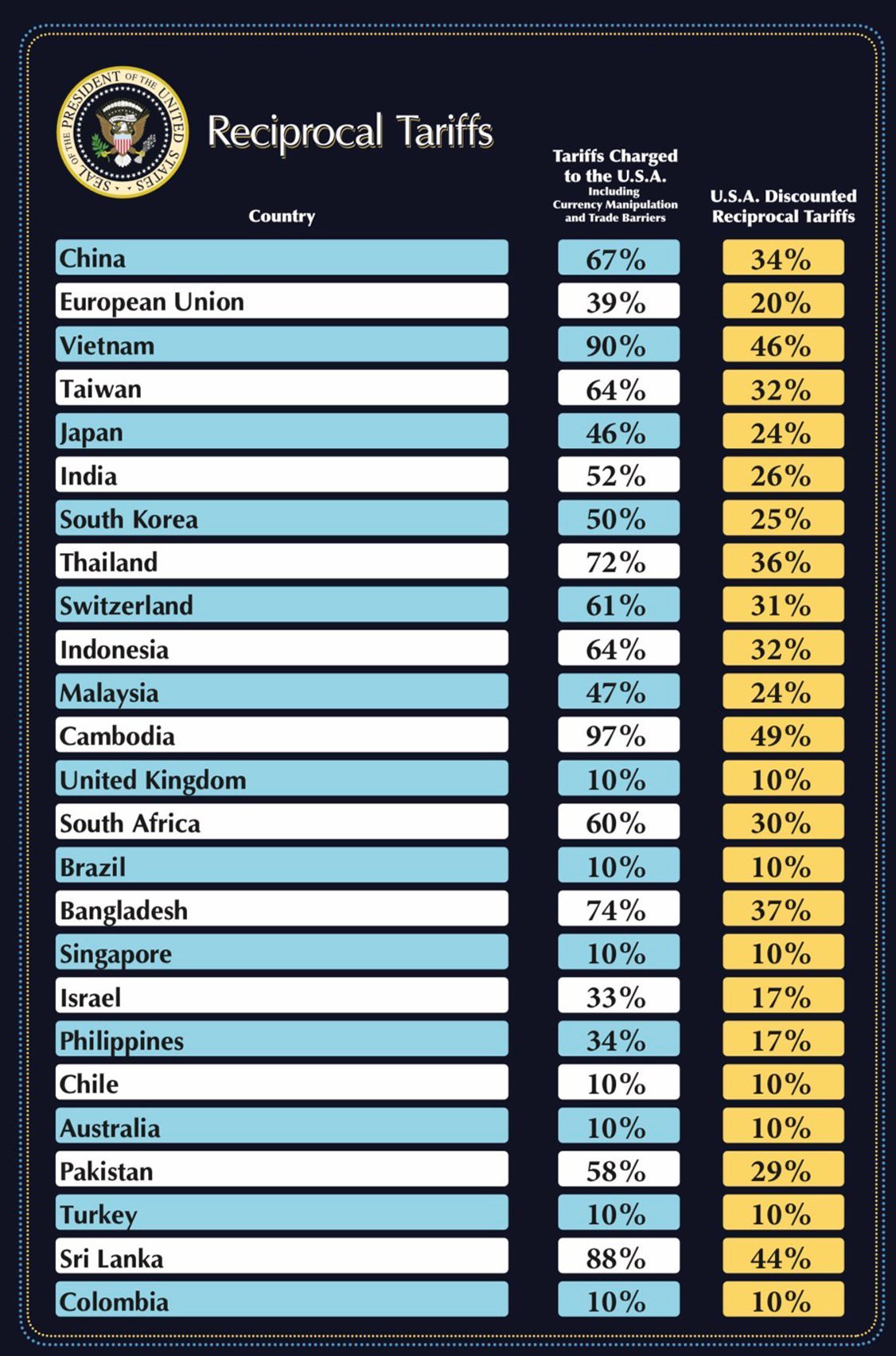
One year ago, President Trump stood in the Rose Garden proclaiming “Liberation Day.” The statute he relied on was more obscure then than it is now: the International Emergency Economic Powers Act, or IEEPA.
Why April 2? Because that meant he could “justify” the tariffs on the basis of “non-tariff barriers” that are, in the Administration’s view, the equivalent of Big Tech and Big Pharma wishlists. Perhaps for that reason, the otherwise highly litigious Chamber of Commerce ultimately took a pass on suing over this one.
But Koch Brother libertarian diehards were not so sanguine. They sued, and the Supreme Court sided with them, striking down the use of IEEPA to impose the tariffs.
Liberation Day and the Supreme Court
Neither those tariffs nor the use of IEEPA to impose them was a good idea. That said, there’s reason to take a closer look at how the Supreme Court decided the case.
The “Liberation Day” tariffs were imposed, according to the President’s Proclamation, because of the trade deficit. Yet his Administration also used them to generate revenue and manufacture negotiating leverage over trading partners. And the President has used IEEPA to impose tariffs having nothing to do with trade, like those on Brazil.
As a former litigator, I did not envy the lawyers defending this case. When your client says one thing over here, and a different thing over there, and yet another thing yonder, you walk into court with a weak hand. That made it all too easy to see the “emergency” for the pretext it was. Like the Court of International Trade, the Supreme Court struck down the tariffs. Unlike the CIT, the Supreme Court concluded that IEEPA doesn’t authorize the use of tariffs at all.
The Court acknowledged that tariffs can be a tool to regulate imports, and IEEPA allows the President to regulate imports. But in concluding that IEEPA does not authorize the President to impose tariffs, the Court relied on the President’s own argument that those tariffs were meant to raise revenue.
It is possible, though, that tariffs under IEEPA could be used for purposes other than raising revenue. For example, a future president could use IEEPA to impose a tariff based on carbon content, with the goal not of raising revenue, but, for example, of limiting – of regulating -- carbon-intensive imports. For that reason, Todd Tucker of the Roosevelt Institute warned early on that opponents of these tariffs might come to rue a Supreme Court decision barring the ability to use tariffs at all.
Justice Gorsuch validated that concern by agreeing that IEEPA does not authorize tariffs, and by noting that a president might argue that climate change is an international emergency and use tariffs for that purpose. The Gorsuch family has a long and unhappy history when it comes to environmental regulation.
To be clear, his opinion was delivered before the “excursion” in the Middle East that raised the profile of energy resilience and energy diversification. And if you’re interested in bipartisanship, then the frame of energy diversification and resilience is the nectar that “climate crisis” is not.
Ideological Context Matters: Ruptures

But this debate over the President’s trade policy is occurring in a much broader ideological context. The foundation of post-Cold War economic governance was laid in the 1970s and ultimately manifested in the World Trade Organization and the surge of “comprehensive” free trade agreements like NAFTA. The goal was to eliminate barriers to trade of whatever kind, including tariffs.
That approach is an extension of Milton Friedman’s Chicago School, which preferred to ignore market power and saw the government as an inept meddler. That is a more extreme position than that of 18th century moral philosopher Adam Smith, who understood power and also considered tariffs a valid policy tool. As did Franklin Roosevelt: the post-war order he sought to create hewed closer to Smith than to Friedman.
At Davos in January, Canadian Prime Minister Mark Carney talked of a rupture in the rules-based order, and of lessons learned from the consequences of “extreme global integration.” Extreme global integration is the result of a post-Cold War rules-based order that privileged capital over labor and rejected the role of government in ensuring that markets operate in the public interest. Left to their own devices, those markets gave us supply chain concentration in geopolitically fraught places -- and inflationary supply shocks.
Affordability: Prices AND Wages
Affordability was the new buzzword even before the latest oil shock, in no small part due to the successful campaign of now-Mayor of New York Zohran Mamdani. Those wedded to the view that tariffs should be banned from the toolbox are latching onto the concept to press their point. The President’s chaotic use of them as part of an overall economic approach that is accelerating inequality makes it easy to continue the old habit of rejecting tariffs as a tool of economic policy.

But affordability is about more than just prices. It is also about income. Even the staunchest advocates of Milton Friedman’s trading system recognize that in the United States, average wages have not kept pace with productivity, and that, while automation is part of the reason, labor arbitrage – offshoring -- is another. The Rand Institute has calculated that the gap between wages and productivity has cost American workers $3.9 trillion.
The President’s mercurial neo-mercantilist approach is a gift to those who attack tariffs. Libertarians and other defenders of the post-Cold War economic order alike take that position. Certainly, tariffs have been a convenient scapegoat for inflation. And while tariffs provide a colorable explanation for price hikes in coffee and tea, they don’t for hospital services or (pre-”excursion”) price hikes in electricity.
Focusing only on tariffs risks failing to address important drivers of rising prices – a mistake no politician can afford to make. The surge in gas prices at the pump has forced the tariffs-are-responsible-for-all-bad-things argument into the background.
But even that means we still have not fully come to terms with the fact that inflationary pandemic supply shocks were the direct result of a post-Cold War system that promoted extreme global integration. The theory was that if the government would only step aside, an unbridled market would usher in new heights of American prosperity and security.
Today, this extreme global integration has led to fragile supply chains, widening inequality and, ultimately, insecurity. We learned the hard way that theory was wrong.
Prime Minister Carney is right: we are experiencing a rupture, not a transition. If we are looking to solve for the unhealthy dynamics that resulted from extreme global integration, then tariffs can be a tool to help us achieve those solutions, including true affordability.
If we use them for that purpose.