
Affordability (ft. the Summers/Tai Debate @ Harvard)
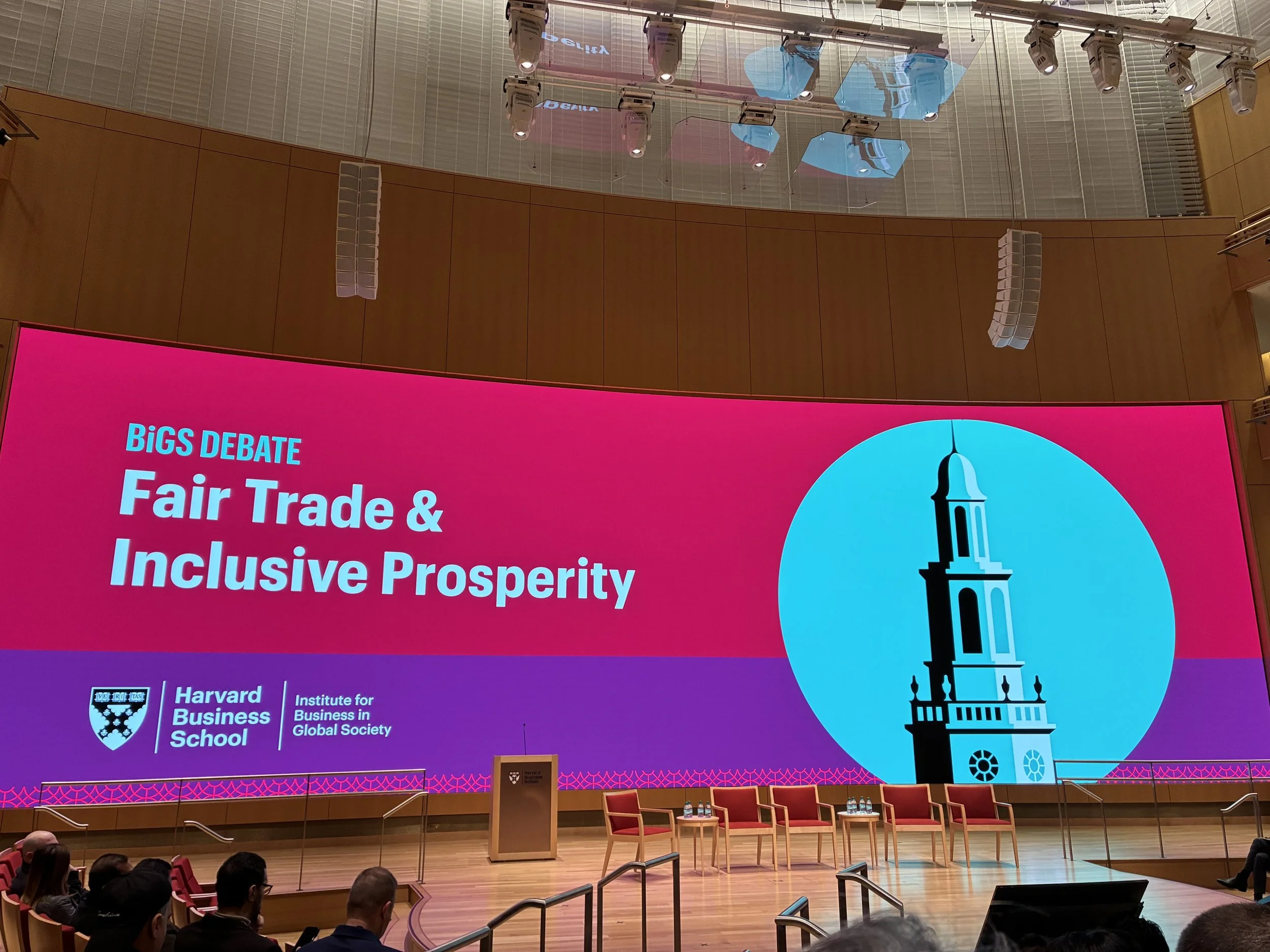
It’s a debate you’ll probably never get to watch yourself. It happened November 5th at Harvard Business School. It was recorded, and that recording was meant to be posted. But there were some, erm, intervening events. The recording isn’t on the site, and chances are it never will be.
But I was there. Here’s my take.
Format
The format was two vs. two: Ambassador Tai and Oren Cass (founder of American Compass), vs. Summers and fellow Harvard professor/Peterson Institute denizen Robert Lawrence. The set-up was sort of cage match-ish. There was a debate question, an audience vote at the outset, the debate itself, and then another audience vote to see if anybody changed their mind.
Audience
The debate was held during the late afternoon at HBS’ Klarman Hall, a breathtaking venue. I’d say there were about 500 people there. Most of them seemed Gen X/Boomer, with a healthy dose of Millenials, and a cadre of students.
The Question that Summers Didn’t Want to Debate
At first, the “specific debate question” was supposed to be:
Is free trade (as implemented in the WTO/GATT system) the best way to ensure prosperity for the United States and its citizens?
As it turns out, though, Summers/Lawrence did not want to debate that question. I don’t blame them. Summers has himself acknowledged that the way we’ve gone about globalization for the last few decades has exacerbated inequality. In 2014 he wrote:
most economists would attribute … rising inequality to the working out of various forces associated with globalization and technological change. For example, mechanization of what was previously manual work quite obviously will raise the share of income that comes in the form of profits. So does the greater ability to draw on low-cost foreign labor.
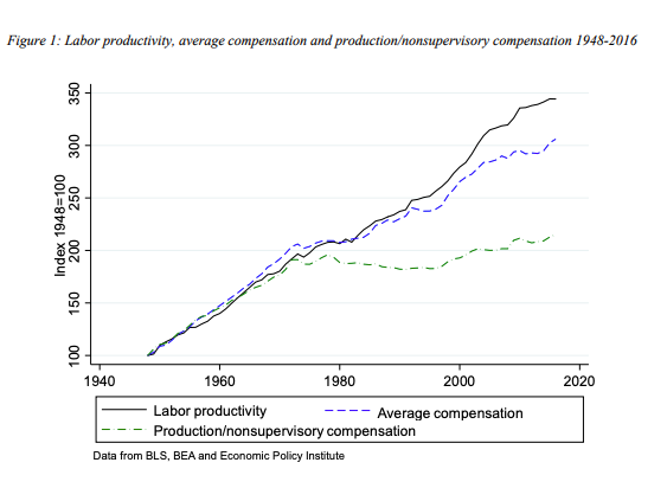
Summers also acknowledged that, during that period, wages flatlined while productivity increased. His analysis shows that the two began diverging at a greater rate around the middle of the 1990s. Now, what happened in the middle of the 1990s?
Tai/Cass could have simply gone on stage, quoted Summers back to himself, and walked off.
And thus, as if in the Grand Bazaar, much haggling over the debate question began in the weeks, day, hours, and minutes leading up to the event. The moderator was compelled to note as much in her intro.
So they ended up with something quite muddled. The question they put on the video screen for people to vote on was more along the lines of “should we stick with the old way of doing trade or do something new?” I don’t know why I should be surprised that, even as the world melts down around us, an audience full of probably-very-rich Gen X HBS types voted 70% “stick with the old way,” but, Dear Reader, I was surprised.
However, even that mashup is not what Summers/Lawrence debated. It became clear over time that what Summers wanted all along was to debate Donald Trump, who, of course, was not there. And so – ignoring all the rules – that’s what Summers/Lawrence did. Summers began his bit with an unctuous “Katherine, my friend.” She is not his friend: he was so apoplectic over this speech that he lit up the White House switchboard to complain about it.
The Summers Arguments
Throughout the debate, Summers had a couple of themes.
Affordability: Summers invoked “affordability” the day after a Blue Wave in which Zohran Mamdani made it a campaign buzzword that centrists like Abigail Spanberger in Virginia and Mikie Sherrill in New Jersey rode all the way to the governors’ mansions. Of course, during the primary, Summers had characterized Mamdani’s policies as “Trotskyite.”
For Summers, though, “affordability” is just semantics. It’s an attempt to rebrand the same old “low price” argument that Milton Friedman pushed back in the day, and which became the justification for laissez-faire globalization – sweatshops, slave labor, pollution.
Cheap stuff at Walmart is well and good, but if workers are making so little that they can only afford to shop at Walmart, and Walmart employees themselves rely on food subsidies from the federal government, then the prioritization of low prices has produced precarity, not affordability.
Which brings us back to Summers’ own recognition that wages have not kept up with productivity gains.
When Mamdani talks about affordability, he’s talking about a New Yorker’s entire lived experience: rent, electricity, child care, wages. And that’s why people respond to it. European consumer groups have used the affordability frame for years.
Good mercantilism. Unsurprisingly, Summers repeated his argument that those old-style trade agreements are “good mercantilism.” I dinged it here back in August. The gist of his argument is that these trade agreements get other countries to lower their tariffs, so that we will increase our exports. Ergo, good mercantilism.
This is sophistry. Pre-Trump, just about everyone else’s tariffs were higher than ours. That’s what we agreed to when we joined the World Trade Organization – under Bill Clinton’s Presidency, where Summers was an influential economic advisor and globalization salesman.
Despite the imbalanced tariffs, we were somehow sure the WTO would be great for our exports. Clinton argued that the way forward for the United States was trade liberalization so that there are “more folks buying what we sell.” This was, apparently, necessary to “keep the American dream alive” and “restore stability to the lives of working people.”
How has that worked out?
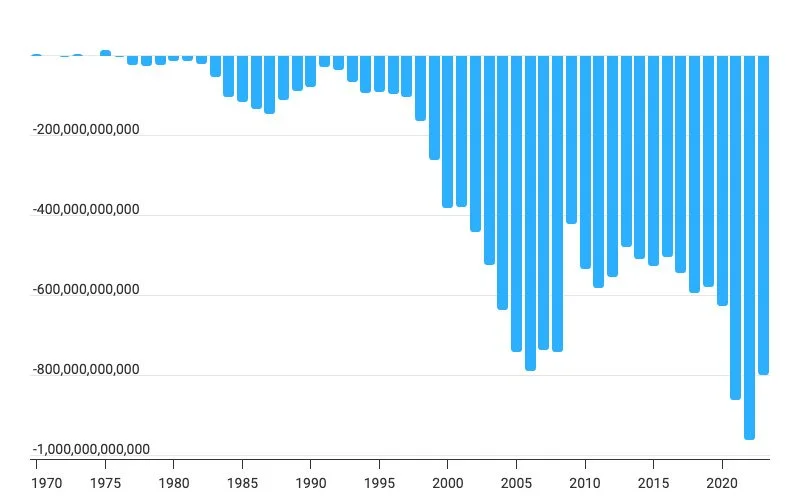
But the very idea that exports were going to lead us to the promised land was flawed from the get-go. Exports are not a big part of the American economic engine. And so the trade deficit – something I don’t talk about much, but if you’re going to talk about “good mercantilism” then I will – exploded after we created the WTO in 1995, and especially after we let China into the WTO at the end of 2001:
Source: Macrotrends
Mercantilism means you are trying to make sure your exports exceed your imports. A fail on that one, Larry.
But what if Larry knows that, and he’s just demagoguing? What if he likes trade deficits but knows he can’t say it out loud, because if he admitted that these deals lead to the offshoring of our industrial base, they’d be dead in the water?
This invites the question as to why Summers would want trade deficits. In Fabulous Failure, Lichtenstein & Stein point out that the Summers/Bob Rubin crowd like that surplus countries such as Japan plowed that surplus into buying U.S. Treasury bonds – thus lowering interest rates:
Rubin and Summers came to see the maintenance of large Japanese trade surpluses as essential to ... the continuation of the low interest rates that were thought a key to American prosperity.... Rubin ... sought to strengthen the dollar against the yen [and] ensured that American manufacturing would have even more difficulty surviving the onrush of ... Japanese cars, steel, and machine tools.
The key to American prosperity — but for whom? As Warren Buffett said, there’s a class war going on, and his side is winning.
But Japan was just a prelude; China was the chance to play the game at scale. Let’s look at Clinton’s comments when he paved the way for China’s entry into the WTO:
China will open its markets to American products from wheat to cars to consulting services, and our companies will be far more able to sell goods without moving factories or investments there.
That didn’t happen. The people who fed Clinton those lines knew it was bullshit. Did he? If he didn’t, he should have. Clinton used the same arguments for NAFTA, but by the time of the China debate in 2000, the U.S. trade balance with Mexico had flipped from positive to negative. Indeed, it flipped in 1995 - just a year after NAFTA entered into force.
Pettis & Klein have explained that massive capital inflows from trade deficits fueled an asset bubble that blew up in 2008. The same Treasury crowd responsible for creating that bubble in the first place subsequently made their way into the Obama Administration. Then, after their previous capital-first policies destroyed the global economy, they made sure the banksters were bailed out — while undershooting stimulus and foreclosing on people in the same communities devastated by offshoring. It’s akin to running someone over with your car – and then backing up and running them over again.
Less than a decade later this same pack of Rubin disciples pushed TPP, more of the same flawed policy. Which they continue to peddle to this day.
The Rebuttal
Having been talked over for a good chunk of her time on stage, Tai made the most of her limited opportunities. She began by framing the debate over globalization as one about the kind of globalization that would best serve our purposes – the Keynesian kind (prioritizing employment), vs. the Friedman kind (prioritizing capital). Someone near me whispered in astonishment “That’s a good point….” Summers’ facial expressions echoed the sentiment. Later on, Tai came back to it by reminding Summers that he himself had claimed in 2006 that “we are now all Friedmanites.”
“I’m glad you got *your* American dream, Larry.”
But the more trenchant point was in response to a bizarre, jingoistic, and tone deaf comment Summers made. He argued that he would rather have been American over these last decades than Japanese, or Chinese, or European, because our economy has been so much better than theirs. Like “good mercantilism,” it’s one of his stock arguments.
Tai reminded Summers of his own acknowledgement that, in the United States, wages haven’t kept up with productivity, inequality is a serious problem, and too many Americans are experiencing economic precarity. To finish it off, she delivered this gut punch: “I’m glad you got your American dream, Larry.”
The Re-Vote
At the end of the scrum, everybody voted again. This time, the vote was 68%-32% -- a 2% swing in favor of the people who didn’t try to rig the debate in the first place.
The Upshot

After Tai congratulated Summers on achieving his personal American dream, a hush fell over the audience, and a few people gasped. Because on November 5, the vibe was very much “Larry Summers is a god.” He got to haggle over the terms of the debate, ignored even that debate question with impunity, debated someone not on stage, trotted out debunked arguments, and managed to be an ugly American on top of it all. The whole affect of the debate wasn’t luminaries engaging in a sincere exchange of views on a topic roiling American democracy, but something closer to a WWE event.
Two days after the Epstein files dropped, HBS sent out an email to attendees. It celebrated the event and included quotes from each debater. Meanwhile, the media was consumed with what was in those files – and in particular Summers’ emails, which exposed all sorts of disturbing issues, from misogyny to abuse of power to an apparent racial slur, all wrapped up in tweener angst over girlz. Was the HBS email merely oblivious, or whistling past the graveyard? As a recipient, I’ll say this much. It felt like a microcosm of the entire elite scandal that is Epstein – and the mismanagement of the global economy these 40 years: a hypoxic bubble detached from the reality going on all around it.