
Davos Woman (Almost)

Another January, another pilgrimage of the Great and the Good to Davos. I was invited to do an event there, even though I am nowhere close to being the female version of “Davos Man.” I did not have Davos on my calendar (or my bingo card) so I will not be able to make it. Alas, I will have no stories to tell of trudging through slush surrounded by buckets of champagne while absorbing cutting-edge ideas about how to funnel more money upwards. But the invitation did inspire me to write up some longstanding musings about Davos.
Let me start with the following quote:
“The purpose of professional management is to serve clients, shareholders, workers and employees, as well as societies, and to harmonize the different interests of the stakeholders…. The management has to serve its employees because in a free society leadership must integrate the interests of those who are led. In particular, the management has to ensure the continuity of employees, the improvement of real income and the humanization of the work place…. The management has to serve society. It must assume the role of a trustee of the material universe for future generations. It has to use the immaterial and material resources at its disposal in an optimal way…. [P]rofitability is the necessary means to enable the management to serve its clients, shareholders, employees and society.”

Holy woke capitalism, Batman!
Holy woke capitalism, Batman! Responsibility to employees and future generations? Free society? Profits for something other than executive compensation and share buybacks and yachts and private planes to fly to places like Davos?
Jack Welch -- he of the fantasy of manufacturing barges that you can move around the world to arbitrage anything in sight -- spins in his grave. He’d have thought those quotes were closer to the Communist Manifesto than the Capitalist Manifesto.
But there’s the rub. It was the Capitalist Manifesto. In fact, it was, literally, The Davos Manifesto. The Davos Manifesto of 1973.
Capitalism used to operate more along these lines, after FDR wrestled American economic royalists to the ground. Keynes advised not to treat even big business as “wolves or tigers, but as domestic animals, even though they have been badly brought up and not trained as you wish.” The current White House occupant is indeed not treating them as wolves or tigers. And he’s having his way with most of them.
If you listened to Elizabeth Warren’s barnburner of a speech earlier this month, you might find that her views on how markets should work aligns well enough with the Davos Manifesto of 1973. After all, she was a Republican until 1995; she left the party because, in her words, it was no longer "principled in its conservative approach to economics and to markets" and became the party that “really stood up for the big financial institutions when the big financial institutions are just hammering middle class American families.” A lot of people share her assessment. So many that maybe one day Larry Summers will find himself abandoning Milton Friedman and declaring instead: “We are now all Warrenites.”
Zohran Mamdani is – always with a smile – unabashedly declaring his social democratic/democratic socialist affinity. As is … former neoconservative Francis Fukuyama (though maybe not with a smile). Even Bill Kristol , whose father founded the neoconservative movement, has said if he had to choose between fascism and social democracy, he’d pick the latter.
As far as I can tell, being a social democrat is much the same as being a New Dealer, which was a lot like being a Keynesian, which was a rejection of laissez-faire. In other words, Mamdani is looking to get back to a political economy that was so popular we ended up amending the Constitution to limit the number of Presidential terms because FDR just kept winning.
Looking back, I now believe one of the biggest failures of our educational system is that we walk away from whatever economics classes we take having learned that models are truth, when in reality they’re grounded in ideology. If you don’t recognize that your “truth” is instead a “belief,” then you won’t adjust to facts, and you’re ill-equipped to move with the times.
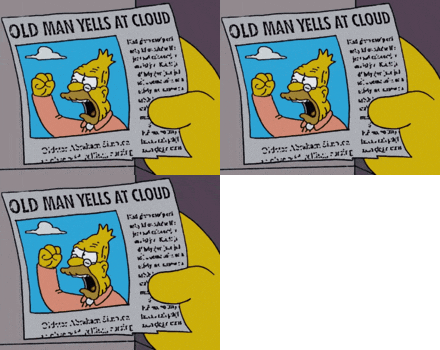
Most people I have encountered in the DC economic policy space don’t factor into their thinking that paradigms shift: in the 20th century, we went from laissez-faire to Keynes to Friedman. Trade poses a particular challenge, because so many Keynesians don’t realize they are decidedly Friedmanite on trade. This, despite the fact that a century ago Keynes abandoned the free trade posture of his youth and criticized the “decadent international but individual capitalism” of the 19th century. Even as the flaws of Friedmanism spell its end, diehards cling to their free trade ideology, raging at those who challenge their deeply held beliefs. Increasingly, they take on the look of Grandpa Simpson shaking his fist at the cloud.

My cohort grew up in the age of Friedman – who would have loathed the Davos Manifesto because the only stakeholder that matters, to his way of thinking, is the shareholder. It’s precisely because Friedman got his way once Ronald Reagan was elected that what was normal to Davos denizens in 1973 reads today as if it were written by Ned Flanders.
“The center holds until it can’t.”
But the same tectonic plates that shifted in Friedman’s favor are now shifting against him. Friedman moved from the fringe to the center (thanks in part to PBS - the ironies abound). But his Darwinian version of capitalism has fewer and fewer takers. Maybe because more and more find themselves at the bottom of the food chain, as the top becomes more and more gluttonous. The center holds until it can’t.
The World Economic Forum updated its manifesto in 2020. I’m not sure why. It’s not better. It seems to have more management-consultant-speak, which is, lamentably, appropriate to our times. But just six years after the manifesto was updated, it turns out that the few interesting parts of what they added are precisely what they won’t stand behind – not least, ESG.
It’s worth remembering that FDR was trying to save capitalism from itself. He succeeded. But today, Davos is such a manifestation of all that’s wrong in the world that Bill Kristol earlier this week doubled down on his stance on social democracy:
Reading about Davos awakens my inner social democrat. A bunch of cosseted and blinkered elites engaging in pompous chit-chat is annoying enough. But at least once upon a time they mostly understood they do a little bit to help defend liberal democracy.
Neocons are becoming social democrats. That’s the paradigm shift in real time. So if Davos wants to manifest something, it should go back to its 1973 principles and live them.
After all, they do still support a free society, right? Right?