
Anti-Fascist Economics
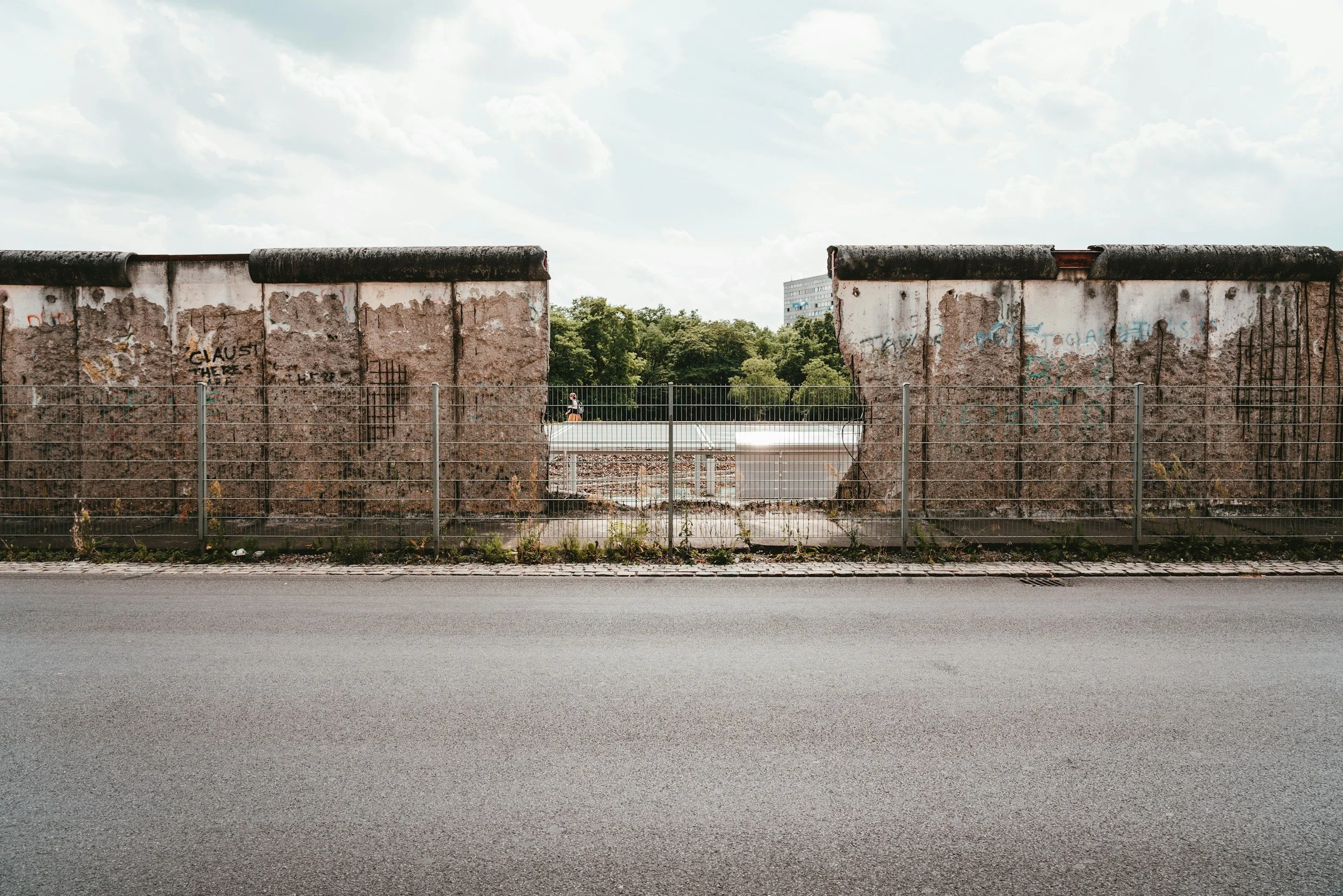
On November 9, 1989, I was a college junior studying in Paris for six months. When the news of the fall of the Berlin Wall broke, a friend organized a trip for a group of us on an overnight bus. I have vague memories of getting to Berlin and witnessing joy and chaos – but the strongest memory I have is of going over to East Berlin and seeing how gray everything was. And I remember looking back over the Wall, back toward the West, and seeing a riot of light, of life. It seemed synonymous with freedom.
In 2024, I read Lea Ypi’s book Free: Coming of Age at the End of History. She grew up in Albania and describes life under communism. But she also describes life under the free market fundamentalism that followed. Conclusions are the reader’s to draw, but mine is that neither regime provided the kind of freedom most of us want: the freedom to live without the oppressive weight of economic precarity. All the light and life on the other side of the Wall came with a price, in the end.
While I was in Berlin that Fall weekend in 1989, I remembered that my college had a program there, too. As I watched the revolution unfold in front of me, I debated whether to apply for the spring term - I’d studied enough German to qualify. I had never planned to spend my entire junior year abroad, and the allure of spring in Northern California was hard to resist. But I knew this was a once in a lifetime opportunity and that I’d regret not doing it.
The Stanford in Berlin program just celebrated its 50th anniversary, and I traveled there for it. There was a local election: getting on the S-Bahn in the old West Berlin, I saw lots of posters for the Green candidate. Getting off in the old East Berlin, I saw lots of posters for the AfD candidate. It struck me that, in a way, the Wall had survived.
That day, the far-right AfD won big in Sachsen-Anhalt, a state the old East. At the reunion, everyone was talking about it, including the Silicon Valley crowd; they were surprised.
I was not.
***
It was with that frame of mind that I read Isabella Weber’s new book, Anti-Fascist Economics. Weber is an economist at Amherst best known for surfacing the argument that inflation during the pandemic was at least partly attributable to price gouging by corporations – “seller’s inflation.” The free market fundamentalists were up in arms: price gouging is not a thing! Markets are just doing what markets do! Weber is a woman! Paul Krugman eventually apologized for calling her argument “stupid.”
Vice President Harris had initially used the price-gouging frame in her campaign, but then the consultant class took the reins and decided that tacking to the center was the way to go. Out went economic populism, in came Liz Cheney. The VP lost every swing state.
Weber’s book gives her the space to explain what seller’s inflation is, why neoliberal economics can’t solve for it, and why going back to the thinkers of the 1930s and 1940s can help us dig ourselves out of the dangerous times we’re living through. It’s impossible to do the book justice in a blogpost, but three points stand out.
First: seller’s inflation happens when supply shocks create room for companies to hike prices by more than the increase in the cost of inputs. When companies have market power – when we don’t live in a world of perfect competition, that is, the real world – companies can use that power to jack up prices beyond the costs they have to absorb. Weber didn’t invent the concept of seller’s inflation: she credits economist Abba Lerner’s work from 1943.
Second: she advocates an economics of essentials. One example is AMLO’s approach in Mexico during the pandemic: he used price controls for a basket of essentials to keep prices in check. In a year when incumbent parties took a beating, his – led by now-President Claudia Sheinbaum - gained seats. She contrasts it with what was effectively the small-yard/high-fence strategy in the United States, where we have been too prone to focus on national security essentials, but not essentials for ordinary people. Essentials include food, housing, health care, and education; ensuring that people have the basics is the hallmark of the rise of FDR-style Democrats in the United States and the corresponding false binary between socialism and capitalism.
Third: she recommends temporary price controls as a mechanism to “buy time” to solve for the supply constraints exposed by the pandemic. In a book full of insights, this one is, for me, as a trade person, the most illuminating and the most urgent. Weber cogently explains why neoliberalism promotes scarcity even when we live in an age of abundance: scarcity is precisely what gives companies room to increase profits. If something is in short supply, people will pay more for it. Think about masks during the pandemic – or toilet paper – the desperation that arises when people can’t access essentials. Ultimately, the price for something that doesn’t exist is infinity. That’s how useless the price mechanism becomes during an extreme supply shock. Yet thanks to our educational system, people of my generation have effectively been brainwashed into thinking the price mechanism is God.
“People of my generation have effectively been brainwashed into thinking the price mechanism is God.”
There is an understandable psychological desire to pretend the pandemic never happened. But it comes at a cost: we have done nothing to address the structural – and inflationary - problem of supply chain fragility brought to us by decades of neoliberal economics. Governments are traveling the world, negotiating pre-pandemic free trade agreements. They either don’t understand, or don’t care, that nothing in those agreements promotes supply chain diversification. If anything, the supply chain rules lock in existing upstream dependencies, and overall perpetuate the privileging of capital over labor.
Mark Carney, a popular global figure who is trying to lead the Middle Powers, is advancing a bill in Canada that walks back the right to strike. It certainly looks like it’s a breach of Canada’s trade agreement with the European Union. This is on the heels of proposals that would apparently do the same on the environment. Even as the EU warmly welcomes him as “Dear Mark” and invites Canada to be an Associate Member (nobody knows what that means), Dear Mark is running a classic labor arbitrage play. Central bankers, amirite?
In addition, Weber points out that hiking interest rates when inflation is driven by supply constraints makes things worse, not better. At a time when you need credit to build out capacity, credit comes dear. Central bankers, amirite?
It also strikes me as a critique of the abundance movement, which I will admit I’ve generally avoided digging into mostly because everything I’ve seen so far seems like rebranded neoliberalism, not least because of the people peddling it. It’s very Reaganesque to hitch your wagon to the theory that government is getting in the way of markets. But as I processed what Weber argues, I wondered how, if developers benefit from a housing shortage, slashing “red tape” changes those incentives? How will less red tape translate into more houses, if the economic incentive is to promote scarcity?
We’ve seen anti-incumbent backlash for years now, but elites persist in promoting a 1990s economic agenda when they should be paying more attention to what Weber is putting on the table. She reups the 1940s discussions around buffer stocks – stockpiles of essential commodities that the government can manage, to smooth out price volatility. It’s an intriguing idea. I’ve raised it with farmers, and to be fair, they’ve responded negatively. But I’m less concerned with whether buffer stocks specifically are the answer – and maybe it’s different for every commodity, but dang if the American strategic petroleum reserve didn’t come in handy after Russia invaded Ukraine – than with having an honest conversation where we’re putting options on the table instead of grabbing our blankie and insisting that markets will fix themselves as democracy collapses around us.
Weber also offers criticisms of Bidenomics, and that’s fair game too. For those of us on the inside, it was so stunning that Biden was willing to reject the Clinton/Obama economic machine and Do Stuff that we, too, failed to appreciate that the cost of essentials was nevertheless crushing people. And that there weren’t enough strings attached to industrial policy, especially with respect to workers’ rights. I’ve heard that from labor unions as well.
The point of critiquing Bidenomics is not to critique Bidenomics: it’s to recognize the ways it broke with the past, but also the ways in which a more profound course correction is needed, and possible.
***
The End of History in 1989 brought with it a return to the free market fundamentalism that delivered freedom for corporations while making life precarious for ordinary people. But in his famous and famously misunderstood book of the same name, Francis Fukuyama points out that the end of history only means that we’ve reached a form of government that cannot be improved upon, liberal democracy. It doesn’t mean we’ll never have ideological conflict again; to the contrary, he points out that history can start all over again.
Ironically, some of the diehard neoliberals of the 1990s – like Fukuyama, like Bill Kristol – are coming to understand that we were allowed to believe that capitalism and democracy would reign supreme precisely because they rested on the bed of the New Deal. Meta just messed with the No Kings Instagram account during voter mobilization, prompting Kristol to ask whether it’s time for antitrust enforcement against tech companies (Bill Kristol!) and invoking his “inner social democrat” because “history does suggest that some social democracy is necessary to correct and save democratic capitalism.” The New Deal was so successful that we were able to take it for granted, like breathing.
When the Berlin Wall fell, free market fundamentalism surged. That’s what Ypi is describing in her book. We thought we were giving people economic freedom, and instead delivered a variation of serfdom. That’s why I was not surprised when the AfD exceeded expectations.
Now that both capitalism and democracy are hanging in the balance (to paraphrase, FDR fascism is feudalism) even the free market fundamentalists (Bill Kristol!) are reevaluating their priors. In fact, it’s worth watching what FDR said in 1937, because it shows how on point Weber is 90 years later:
This is precisely why Weber’s book is so important. We’ve been here before, and she’s done the work for us of going back to the economists who lived through fascism, who said “never again.” These are the thinkers who got memory-holed after the fall of the Wall took with it the threat of communism. Organized labor lost leverage, and it opened the door for capital to dominate - again.
There’s a reason so many of us are finding kindred spirits in the people who built the post-war peace. Those people had lived through hell on earth and hoped to spare us living through it again. We screwed up. The “end of history” led us to believe their ideas were obsolete; we’re finding out the hard way they’re anything but.